Most manufacturing organizations have some form of Production Planning in place. Yet despite having production plans, many companies continue to struggle with delayed deliveries, rescheduling, bottlenecks and constant firefighting. The reason is simple: having a production plan and having the capacity to execute that plan are two different things. This is where Shop Capacity Planning (SCP) becomes critical.
Understanding Production Planning
Production Planning focuses on what should be produced, in what sequence, and by when. It aligns sales orders, material planning, production and dispatch into a single schedule. It answers the question of intent — the order in which work is meant to flow through the organization.
Why Production Planning Works Well in Automobile Manufacturing
In automobile manufacturing, products, processes, routings and cycle times are highly standardized. Schedules remain relatively stable and capacity requirements are predictable. This consistency is exactly why traditional production planning systems perform so effectively in that environment.
The Reality of Project Engineering and Job-Shop Manufacturing
In project engineering environments — pressure vessels, heat exchangers, skids, structural fabrication and custom machinery — every order is different. Drawing revisions, material delays, rework and changing customer priorities are common. Here, change is not an exception; it is the norm.
Daily Challenges Faced by Planning Engineers
On any given day, the original plan is disrupted by a familiar set of pressures:
- Drawing revisions that change scope mid-stream
- Material availability issues that stall ready work
- Rework and rejections that consume planned capacity
- Urgent customer priorities that jump the queue
As a result, schedules need frequent revision — sometimes several times a day.
The Real Challenge
The real challenge is not creating a plan. The challenge is ensuring that revised priorities and schedules reach the shop floor quickly, so that machines, supervisors and operators are all aligned to the same, current reality.
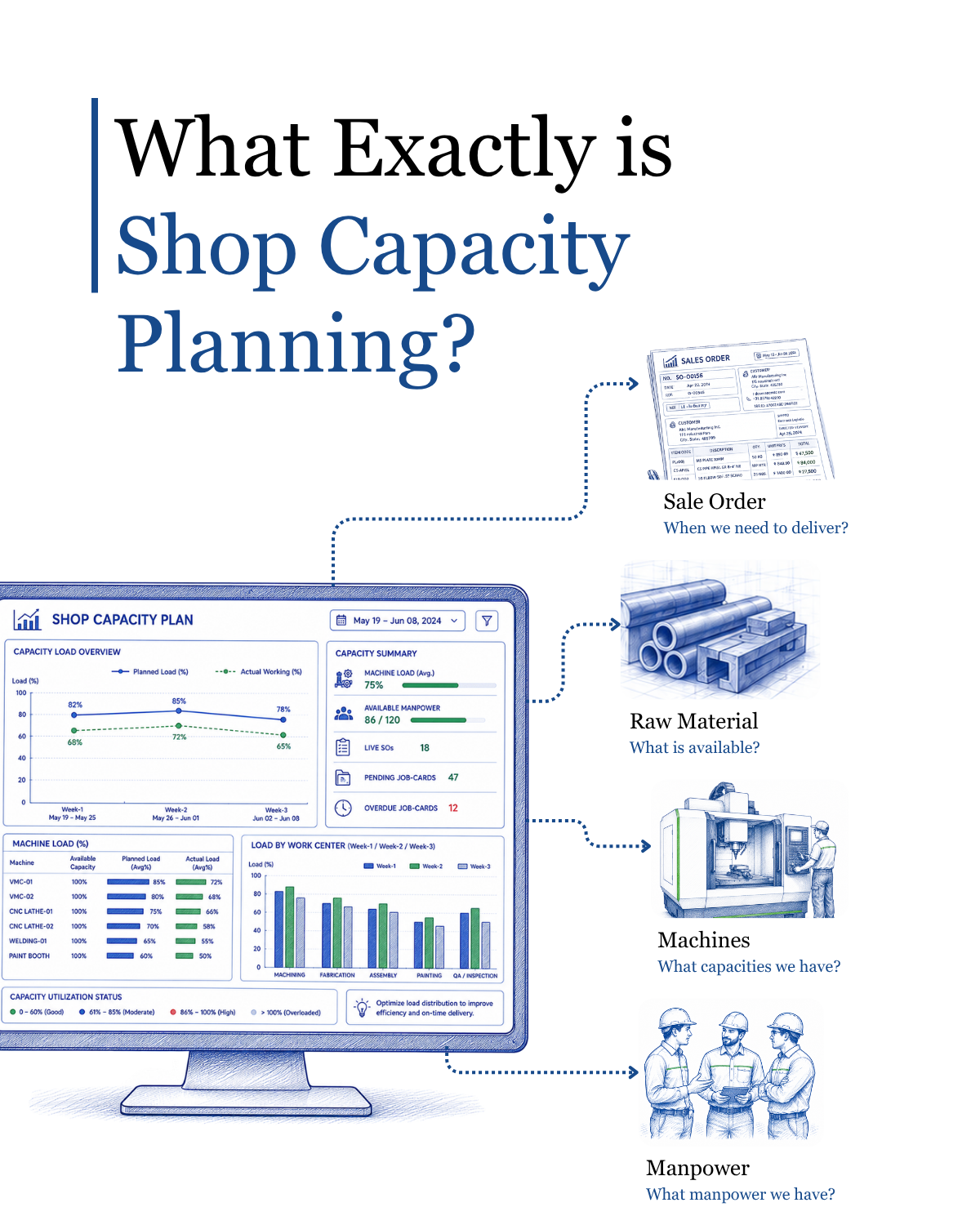
What Exactly is Shop Capacity Planning?
Shop Capacity Planning continuously aligns orders, materials, machines, manpower and priorities with actual shop-floor capacity. Instead of asking only what should be produced, it asks whether the organization can realistically produce it.
Benefits of Shop Capacity Planning
SCP gives planners and management clear visibility into:
- Machine utilization
- Manpower availability
- Material readiness
- Bottlenecks and delivery risks
- Overall production health
With this visibility, teams can make proactive decisions instead of reacting through constant firefighting.
Practical Example
When an urgent export order arrives, SCP evaluates machine capacity, manpower availability, material readiness and the impact on existing commitments before rescheduling work. This transforms planning from guesswork into informed decision-making.
Why Directors and Plant Heads Should Care
Most delivery failures are caused by a lack of visibility rather than poor execution. SCP helps management identify bottlenecks early, make realistic commitments and improve on-time delivery performance — protecting both margins and customer trust.
Conclusion
Production Planning creates schedules. Shop Capacity Planning creates confidence. In project engineering environments where priorities change frequently, capacity visibility becomes essential for reliable delivery performance.